What is Magnet Wire?
The term “magnet wire“ is used to describe solid conductor wire—usually copper—insulated with a polymer-based film. The films are designed to provide a uniform dielectric coating while taking up as little space as possible.
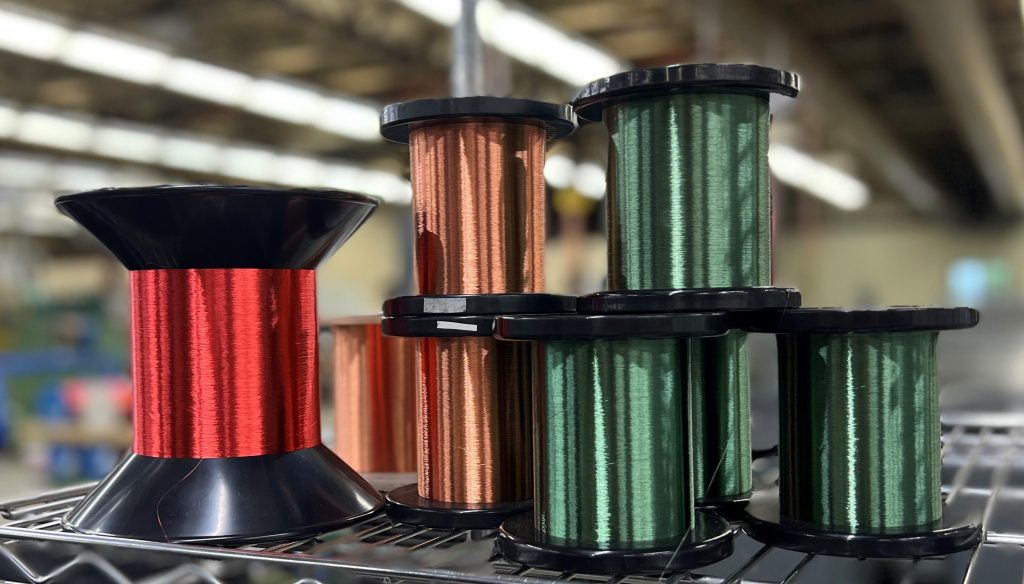
In specifying a magnet wire, there are several areas an engineer needs to be concerned with including:
- Size or Diameter
- Insulation Thermal Class
- Insulation Build or Thickness
- Color and Coatings
All the magnet wire used in manufacturing our Litz wire is certified to the most rigorous requirements of federal, NEMA and military specifications.
The chart below displays some commonly used magnet wire film insulations. Please note, this is not an exhaustive list and other options may be available for your project.
| Insulation | Temperature Range | Gauge | Advantages | Considerations |
|---|---|---|---|---|
| Polyvinyl Formal | Class 105C MW 15-C | 14-50 | Excellent abrasion resistance Excellent compatibility with transformer oils Good electrical properties Used in cryogenic applications | Must be stripped before soldering Should be annealed before application of varnish |
| Polyurethane | Class 155C MW 79-C Class 180C MW 83-C | 30-50 24-50 | Excellent electrical properties for high Q coils Easily solderable 390C/360C Excellent film adhesion & flexibility Good moisture & chemical resistance | Not recommended for applications with the possibility of severe thermal overload |
| Polyurethane-Nylon | Class 155C MW 80-C Class 180C MW 83-C | 10-46 25-46 | Good electrical properties Easily solderable 430C/390C Excellent film adhesion & flexibility Nylon topcoat provides low coefficient of friction and improved chemical & mechanical resistance | Not recommended for applications with the possibility of severe thermal overload Nylon topcoat is hygroscopic |
| Solderable Polyester | Class 180C MW 78-C | 14-50 | Solderable 470C Excellent thermal properties Good electrical properties Good compatibility with varnishes & solvents Improved thermal overload Good moisture resistance | Low abrasion resistance compared to nylon & amide-imide topcoats Preheat before varnishing is recommended |
| Solderable Polyester Nylon | Class 180C MW 78-C | 14-50 | Solderable 470C Excellent thermal properties Good electrical properties Good compatibility with varnishes & solvents Improved thermal overload Good moisture resistance Nylon topcoat provides low coefficient of friction | Nylon topcoat is hygroscopic Preheat before varnishing is recommended |
| Polyester Amide-Imide | Class 200C MW 74-C | 34-44 | Excellent flexibility & abrasion resistance Excellent thermal overload Excellent dielectric strength Excellent moisture resistance Good chemical resistance | Must be stripped before soldering Not recommended for use in oil-filled transformers Preheat before varnishing |
| Polyester/Polyamide-imide | Class 200C MW 35-C | 8-33 | Excellent flexibility & abrasion resistance Excellent thermal overload Excellent dielectric strength Excellent moisture resistance Good chemical resistance | Must be stripped before soldering Preheat before varnishing |
| Polyimide | Class 240C MW 16-C | 10-30 | Excellent flexibility Excellent thermal overload Excellent dielectric strength Excellent moisture & chemical resistance Adequate abrasion resistance Low outgas | Must be stripped before soldering Must be annealed before varnishing Will solvent craze |