Tapes and Fibers
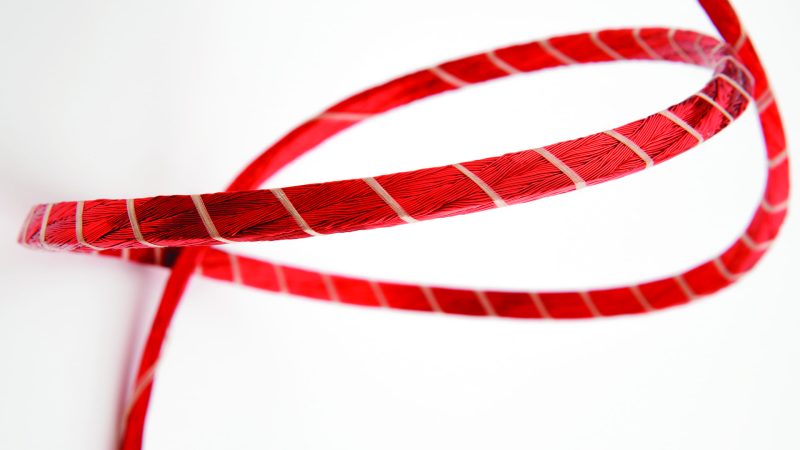
Litz wire, may be “served” or “unserved.” To be “served” simply means that the entire Litz wire construction is wrapped with a textile or yarn for added strength and protection.
“Unserved” Litz magnet wire has no wrapping or insulation. In either case, the use of additional tapes or insulations may be utilized to help improve voltage-withstand and protect the Litz wire against damage during winding. Fiber and tape insulations are typically thin and well-suited for low voltage applications.

The tables below show some of the commonly used tapes and fibers, but more options are available. If you need any assistance selecting a material type, just contact us – we’re here to help!
Tape Insulation
| Tape Insulation | Recommended Maximum Operating Temperature | Characteristics |
|---|---|---|
| Polyester (PET) Mylar® (heat sealable grades available) | 135° C | High dielectric strength Good abrasion resistance Used as binder or barrier under extruded jackets and textile serves or braids |
| Nomex® (aromatic polyamide) | 200° C (up to 220° C under certain conditions) | Excellent electrical & thermal properties Good tear and abrasion resistance Excellent compatibility with varnishes, adhesives, and transformer fluids Thinner grades are flexible |
| Polyimide Kapton® (heat sealable & adhesive grades available) | 240° C (up to 400° C under certain conditions) | Excellent mechanical properties Excellent dielectric strength Very good chemical resistance UL 94 V-0 flame rating |
| Fiberglass Cloth | Determined by application & glass type | Excellent electrical properties at high temps Excellent solvent resistance Conformable Varnish compatible grades available |
| Mica | Determined by application & glass type | Excellent electrical properties at high temps Excellent solvent resistance Conformable Varnish compatible grades available Flame resistant Retains useful electrical properties during and after exposure to fire |
Fiber Insulation
| Fiber Insulation | Recommended Maximum Operating Temperature | Characteristics |
|---|---|---|
| Cotton | 135° C | Low cost Good abrasion resistance Poor space factor vs. nylon or polyester Non-solderable |
| Nylon | 155° C | Excellent abrasion resistance Good space factor Solderable Hygroscopic |
| Polyester | 155° C | Good abrasion resistance Slightly higher max operating temp than nylon Better space factor than cotton, but poorer than nylon Solderable |
| Nomex® | 250° C | Higher cost Good electrical properties at high temperatures Good space factor Non-solderable |
| Glass | 260° C | Good electrical properties at high temperatures Poor space factor Non-solderable |